Manual task hazard awareness: free online awareness course for New Zealand workers
Spot what makes a manual task risky, report it early and know what better controls look like. Drawn from WorkSafe guidance. Not lifting technique or moving people.
About 31 min
4 short modules
14 questions
85% to pass
About this course
Lifting, carrying, pushing, pulling and repeating the same movement all day can wear your body down. This short course shows you what makes a manual task risky, how to report it so it gets fixed, and what better controls look like. It suits cleaners, kitchen and bar staff, housekeepers, stockroom and office staff, and the team leaders who act on their reports.
It is not a lifting technique course. WorkSafe says manual handling, or how-to-lift, training does not reduce musculoskeletal disorders, such as sprains, strains and ongoing pain, so this course looks at the task instead. It does not cover moving and handling people, and it does not train you on any equipment. If your employer requires workplace health and safety training, ask whether they provide or fund it before purchasing this optional certificate.
You can study and sit the assessment free, with no account. WorkSafe's own guidance and checklists are free too, and they are linked on this page. Pay only if you pass and want our certificate for your own records.
What you will learn
Explain why how-to-lift training on its own is not treated as an effective control
Identify what makes a task risky: force, posture, repetition, vibration, the load, the environment and pace
Rank controls from changing the task down to training, and recognise stronger and weaker ones
Report a risky task or faulty equipment in a useful way, following your workplace's process
Recognise early discomfort as something to report, and describe the first steps if you are hurt
Who this course is for
Workers whose jobs involve lifting, carrying, pushing, pulling, reaching or repeating a movement, such as cleaners, housekeepers, and kitchen and bar staff
Office and stockroom staff who shift boxes or spend long periods in one position
Team leaders who want to notice risky tasks and act on reports
How the course works
1. What this course is, and whyWhy WorkSafe does not treat how-to-lift training as an effective control, what this course leaves out, and what these injuries are.About 6 min, ending with a quick check
2. Spotting what makes a task riskyForce, posture, repetition, vibration, the load, the environment and pace, and how they stack up.About 6 min, ending with a quick check
3. What better controls look likeRedesigning the task, using equipment and changing how work is organised, and who decides.About 6 min, ending with a quick check
4. Reporting tasks and early discomfortWhat to report, how to say it, the first steps if you are hurt, and who pays for what.About 6 min, ending with a quick check
Sit the assessment14 questions drawn at random. You need 85% to pass, and there is no time limit. If you do not pass, you will see which topics to review, then try again with a new set of questions.Free, and so are retries
If you pass, the certificate is your choiceYou pay once, then get the PDF straight away and a copy by email. Your place is saved on this device the whole way, with no sign-up.NZ$24.90, optional
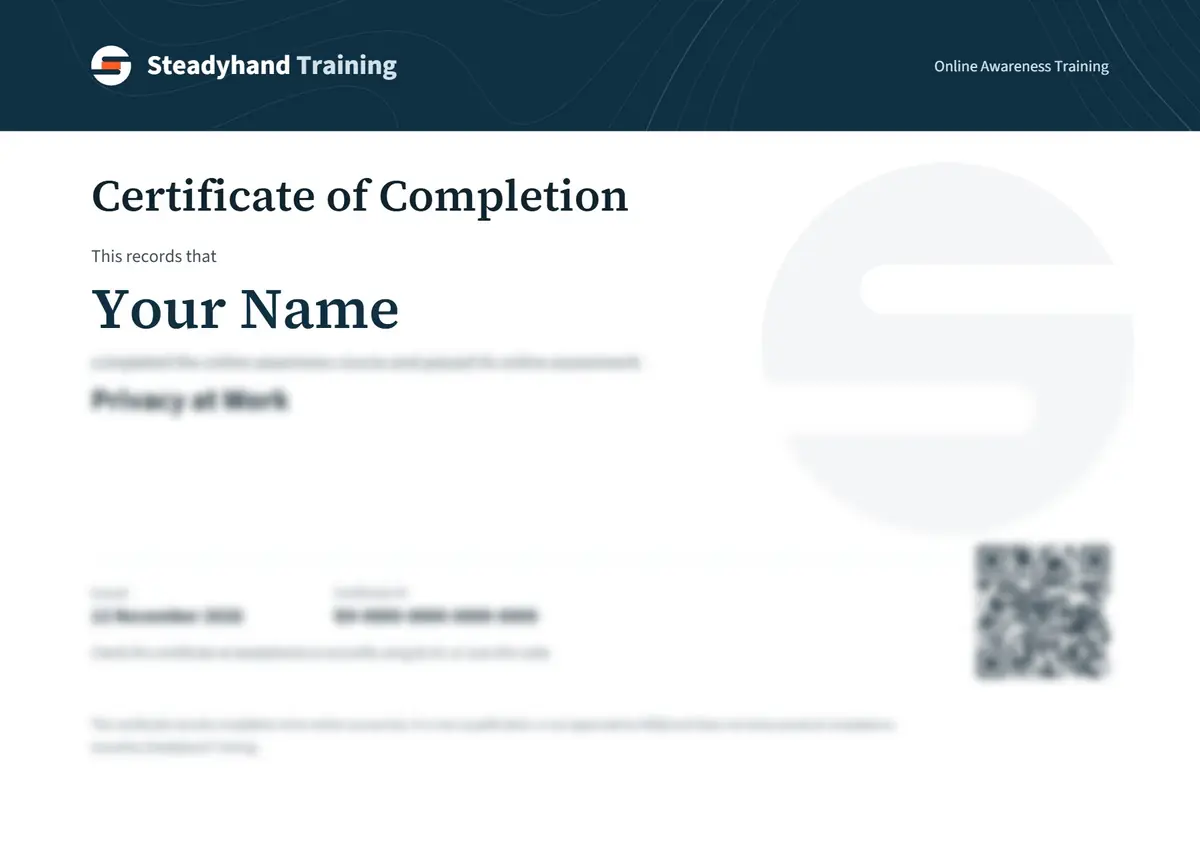
Sample. Yours shows your name, the course, the date and an ID anyone can check.
What this certificate does and does not show
It does not teach lifting technique. WorkSafe says how-to-lift training does not reduce musculoskeletal disorders.
It does not cover moving and handling people. That needs hands-on training at your workplace, with the equipment you will use.
It does not train you on any equipment, such as a trolley, pallet jack, hoist or machine. Training on your own tasks and equipment has to come from your workplace.
It is not a qualification. A pass does not show that you can do a task safely, or that a business has met its duties.
If your employer requires workplace health and safety training, ask whether they provide or fund it before purchasing this optional certificate. This awareness course does not replace workplace-specific training or induction.
It is not medical advice. See a doctor or other health provider about pain or injury.
Not in the usual sense. It does not teach lifting technique, because WorkSafe says how-to-lift training does not reduce musculoskeletal disorders. It covers spotting and reporting risky manual tasks, and what better controls look like. If your employer has asked for a manual handling course, ask what they need and whether they will provide it.
Will this teach me to move or help people?
No. Moving and handling people needs hands-on training at your workplace, with the equipment you will use. ACC's guidelines say interactive, hands-on training should be an industry standard for this work, and that lectures or videos alone are not effective for teaching these techniques.
Will my employer accept the certificate?
Ask them first. Each employer decides what training it accepts, and the certificate cannot replace training on your workplace's own tasks and equipment. If your employer requires workplace health and safety training, ask whether they provide or fund it before purchasing this optional certificate. The optional certificate costs NZ$24.90.
Is there a safe weight I can lift?
This course does not give one. The WorkSafe material it draws on looks at many factors together: the load, posture, repetition, the environment, pace and the person. WorkSafe's screening tools help businesses decide when a task needs a closer look. Ask your supervisor about your workplace's own rules.
My back or wrist hurts. What should I do?
See a doctor or other health provider, who can make an ACC claim for you if it applies, and tell your workplace so that the task can be looked at. This course is not medical advice.
What free options are there?
WorkSafe's page on how-to-lift training links two free documents, and its screening tools and checklist are on its website. ShopCare has free resources for retail and supply chain businesses. They are linked on this page, and you may prefer them.
Official sources behind this course
The lessons are original summaries of these sources. For your own situation, the source is what counts.
Version 1.1.2, last checked 2026-11-03. Approved for publication by our editor on 2026-11-09. Not reviewed by an external professional. How we check our content.
Your rights and duties under New Zealand's Health and Safety at Work Act: reporting hazards, stopping unsafe work, HSRs, PPE, and the changes from 1 April 2027.
Clean before you disinfect, read labels and safety data sheets, never mix products, handle wet floors and lone work, and know what to leave alone and report.