Dementia awareness: free online course for New Zealand caregivers and support workers
What dementia is and is not, common changes, respectful communication, and what to notice and report about distress, choices, walking, eating and whānau.
About 40 min
6 short modules
18 questions
85% to pass
About this course
Ngaio is looking for her cardigan for the third time this morning and getting upset. Colin pushes your hand away in the shower. A daughter asks whether her father is getting worse. This course explains what dementia is and is not, simple ways to communicate respectfully, why distress may be a sign of a need, what the Code of Rights says about choice, and what to notice and report about walking, eating, swallowing and whānau.
Your employer's induction, each person's care plan and the nurse or coordinator you report to come first. This course is general background. It does not teach medicines, restraint, managing behaviour, helping people eat or move, or any other clinical task, because those belong to the care team, and it does not replace hands-on training or sign-off.
You can study and sit the assessment free, with no account. Alzheimers New Zealand's Dementia Learning Centre, including its Dementia Friends course, and Te Pou also offer free online learning. They are linked on this page, and you may prefer them. If your employer wants you to have dementia training, ask what they provide before you buy anything. Pay only if you pass and want our certificate for your own records.
What you will learn
Describe what dementia is and is not, and recognise that a sudden change must be reported straight away
Recognise common changes in memory, language, mood and everyday tasks
Describe the Four S's and other simple habits that make communication easier
Recognise that distress may be a sign of a need, and know what to write down and whom to tell
Describe what the Code of Health and Disability Services Consumers' Rights says about dignity, choice and refusal, and know when to involve your supervisor
Know whom to tell about changes in walking, eating, drinking and swallowing, and when to call 111
Recognise when whānau may need support and know where to point them
Who this course is for
Caregivers and support workers in rest homes, private hospitals and home support
New staff who have started supporting someone living with dementia
People thinking about care work who want to understand dementia first
How the course works
1. What dementia is and is notWhat the word means, why memory problems are not always dementia, and why a sudden change needs urgent attention.About 5 min, ending with a quick check
2. Common changesWhat you may see in memory, language, mood and everyday tasks, what stays, and how to report it.About 4 min, ending with a quick check
3. Communicating wellThe Four S's, small habits that help, what to avoid, and what to do when what someone says is not true.About 5 min, ending with a quick check
4. When distress is communicationLooking for the need behind distress, writing down what you see, keeping out of harm's way and telling the team. Medicines, restraint and behaviour plans belong to the care team.About 5 min, ending with a quick check
5. Choices and dignityWhat the Code of Rights means on shift, small everyday choices, when someone says no, and raising concerns.About 5 min, ending with a quick check
6. Walking, eating and whānauWalking and getting lost, changes in eating and swallowing to report, and supporting whānau.About 6 min, ending with a quick check
Sit the assessment18 questions drawn at random. You need 85% to pass, and there is no time limit. If you do not pass, you will see which topics to review, then try again with a new set of questions.Free, and so are retries
If you pass, the certificate is your choiceYou pay once, then get the PDF straight away and a copy by email. Your place is saved on this device the whole way, with no sign-up.NZ$24.90, optional
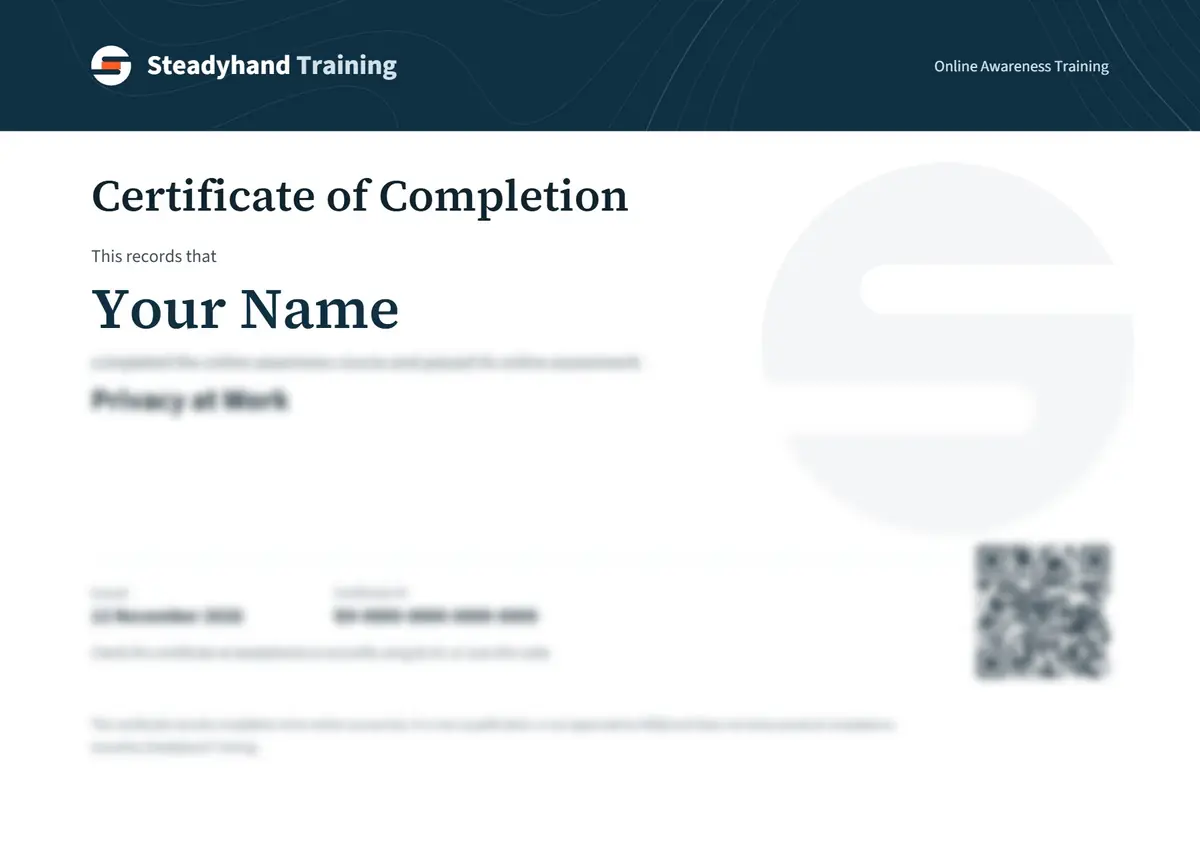
Sample. Yours shows your name, the course, the date and an ID anyone can check.
What this certificate does and does not show
This is general awareness for care work. Your employer's induction, the person's care plan and sign-off on each task come first, and nothing here shows that you can safely do any task.
It does not teach medicines, restraint, techniques for managing behaviour, swallowing or feeding techniques, moving people, or any other clinical task. Those belong to the care team and your workplace's policies.
It does not help you diagnose dementia or delirium. If someone changes suddenly, tell the nurse, your supervisor or your coordinator straight away.
It does not help you decide whether someone is competent to make a decision, or who decides for them. Ask your supervisor.
It teaches no tikanga and makes no claim about cultural safety. Ask the person and whānau what matters to them, and follow your organisation's guidance.
It is not a qualification. It earns no credits toward Health and Wellbeing qualifications at Levels 2 to 4, gives no pay-equity step or equivalence, and does not help any provider meet Ngā Paerewa.
It is not medical or legal advice. If you are worried about someone's health, talk to the care team, or call their doctor or Healthline on 0800 611 116. In an emergency, call 111.
Yes. Alzheimers New Zealand's Dementia Friends is a free 20-minute online course, and its Dementia Learning Centre has other free learning. Te Pou has a cognitive impairment module at no charge, but it is written for alcohol and other drug workers rather than for dementia care. They are linked on this page, and if you only want a basic understanding, Dementia Friends may be all you need.
Will my employer accept the certificate?
That is your employer's decision, so check with them first. Your employer's induction and each person's care plan come first. You can study and sit the assessment here free before you decide whether a certificate is worth NZ$24.90 to you.
My employer wants me to have dementia training. Do I have to pay for it?
Ask your employer what they provide before you spend anything. Studying here and sitting the assessment are free. The optional NZ$24.90 certificate is a record for yourself, so do not buy it just because someone told you to.
Does this teach me how to handle aggression, give medicines or use restraint?
No. Those belong to the care team and your workplace's policies. This course helps you notice distress, keep out of harm's way, get help and tell the right person. If you are asked to do something you have not been trained for, talk to the registered nurse or your manager.
I care for a relative at home. Is this course for me?
You are welcome to use it, but it is written for paid workers. Alzheimers New Zealand and Dementia New Zealand have free information written for whānau, and calling 0800 004 001 reaches a local Alzheimers organisation.
Does this count toward Ngā Paerewa, a qualification or pay equity?
No. It is not a qualification. It earns no credits toward Health and Wellbeing qualifications at Levels 2 to 4, gives no pay-equity step or equivalence, and does not help any provider meet Ngā Paerewa.
Official sources behind this course
The lessons are original summaries of these sources. For your own situation, the source is what counts.
Show all 36 sources
Dementia Health New Zealand | Te Whatu Ora. Checked 2026-11-07.
Delirium Health New Zealand | Te Whatu Ora. Checked 2026-11-07.
Version 1.1.0, last checked 2026-11-03. Approved for publication by our editor on 2026-11-09. Not reviewed by an external professional. How we check our content.
For your first weeks as a caregiver or support worker: who does what, people's rights, dignity, whānau, noticing and reporting changes, home visits and speaking up.