Record keeping at work: free online awareness course for New Zealand workers
How to write factual, timely notes, correct mistakes honestly, handle incident and complaint records, and understand who may read records and how long they are kept.
About 37 min
5 short modules
15 questions
80% to pass
About this course
You finish a long shift and realise you never wrote up what happened with a client at lunchtime. You could add it now and put the earlier time on it. This course explains why that is a bad idea, and what to do instead.
It covers everyday notes, timesheets, incident and complaint notes, who may read them and how long they are kept. The retention table names who each rule applies to, so you can see what does and does not apply to your job.
You can study and sit the assessment free, with no account. Free privacy training from the Privacy Commissioner and a short Inland Revenue video on business records are linked on this page, and you may prefer them. Pay only if you pass and want our certificate.
What you will learn
Explain why accurate records matter to clients, colleagues and you
Write notes that record facts rather than opinions, at or close to the time
Correct a mistake without hiding it, and explain why backdating and altering records are wrong
Record what is needed after an incident or a complaint
Work out who may read a record, and how to keep it safe
Find the retention rule for a type of record, and check before anything is thrown out
Who this course is for
Care and support workers who write progress notes or daily logs
Early childhood workers who keep attendance, incident and medicine records
Office workers and team leaders who deal with timesheets, complaint notes or client files
How the course works
1. Why records matterWhat good records do, what can go wrong without them, and your part whatever your job.About 5 min, ending with a quick check
2. Facts, written at the timeHow to record what you saw, heard and did, when to write it, and how to keep it readable.About 6 min, ending with a quick check
3. Correcting mistakes honestlyHow to fix an error without hiding it, how to add a late entry, and why backdating and altering are never the answer.About 6 min, ending with a quick check
4. Incident and complaint notesWhat to put in an incident note, when an event may need notifying, and how to record a complaint fairly.About 6 min, ending with a quick check
5. Who may read records, keeping them safe, and how longAccess to records, simple ways to protect them, and a table of retention rules with who each one applies to.About 7 min, ending with a quick check
Sit the assessment15 questions drawn at random. You need 80% to pass, and there is no time limit. If you do not pass, you will see which topics to review, then try again with a new set of questions.Free, and so are retries
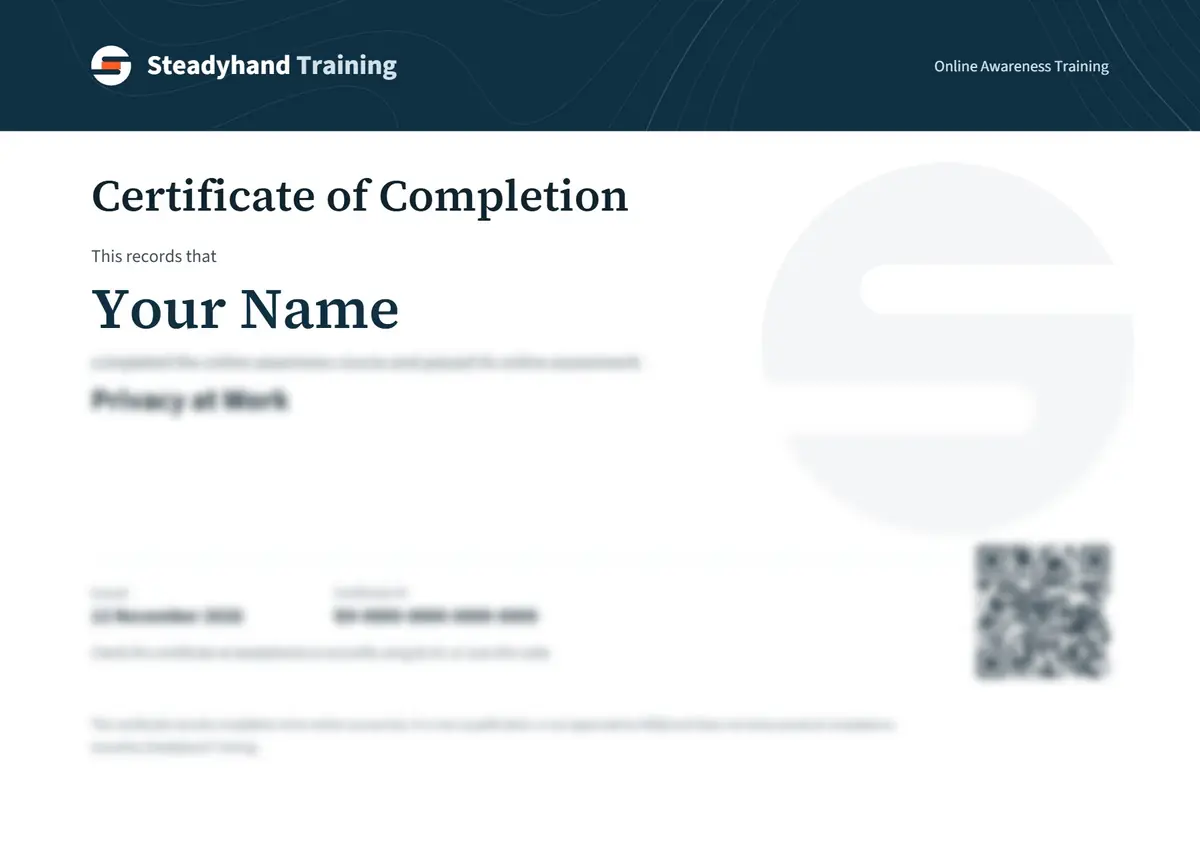
If you pass, the certificate is your choiceYou pay once, then get the PDF straight away and a copy by email. Your place is saved on this device the whole way, with no sign-up.NZ$24.90, optional
Sample. Yours shows your name, the course, the date and an ID anyone can check.
What this certificate does and does not show
This is general awareness. It is not legal advice, and it does not tell your employer which records to keep.
Your workplace's own system and rules come first. Sector rules, such as those for licensed early childhood services or health and disability services, go into more detail than this course can.
The retention table covers the rules we could verify. It is not a complete list of every record a business must keep.
Where a tip is our own practical advice rather than a rule, the lesson says so.
If you go straight to the assessment without completing the modules, your certificate is titled Certificate of Knowledge Assessment, because that is what it records.
Does this course tell me which records my workplace must keep?
No. It covers how to write and look after records, with a table of retention rules we checked. Your employer decides how its records work, and your sector may have its own rules. Ask your manager if you are unsure.
Is backdating always a crime?
Not always. Section 258 of the Crimes Act 1961 depends on an intent to deceive for gain or to cause loss. Backdating is still wrong at work, because it makes the record false, and it can lead to serious consequences for you. Use a late entry instead.
What if my workplace's procedure differs from this course?
Follow your workplace's procedure, which may be tailored to rules for your sector. If you think it leads to false or misleading records, raise that with a manager.
How long do I personally have to keep records?
Most of the rules we checked put the duty on the employer, business or provider, not on individual workers. If you run your own business, the rules for businesses apply to you. Keep work records where your workplace says to keep them, not at home.
Is this legal advice?
No. It is general information to help you keep good records. If you have a specific legal problem, talk to Employment New Zealand, Community Law or a lawyer.
Will my employer accept the certificate?
Check with them first, because each employer decides what training it accepts. Health, disability and early childhood employers may run their own documentation training. The lessons and assessment are free, so you can decide about the certificate later.
Official sources behind this course
The lessons are original summaries of these sources. For your own situation, the source is what counts.
Show all 26 sources
Record-keeping Employment New Zealand. Checked 2026-11-03.
Version 1.1.0, last checked 2026-11-03. Approved for publication by our editor on 2026-11-09. Not reviewed by an external professional. How we check our content.
Your rights and duties under New Zealand's Health and Safety at Work Act: reporting hazards, stopping unsafe work, HSRs, PPE, and the changes from 1 April 2027.
38 min
5 modules
Free to study
Certificate NZ$24.90if you pass
View course
Passed 2 or more courses? Buy their certificates together and pay 20% less.